
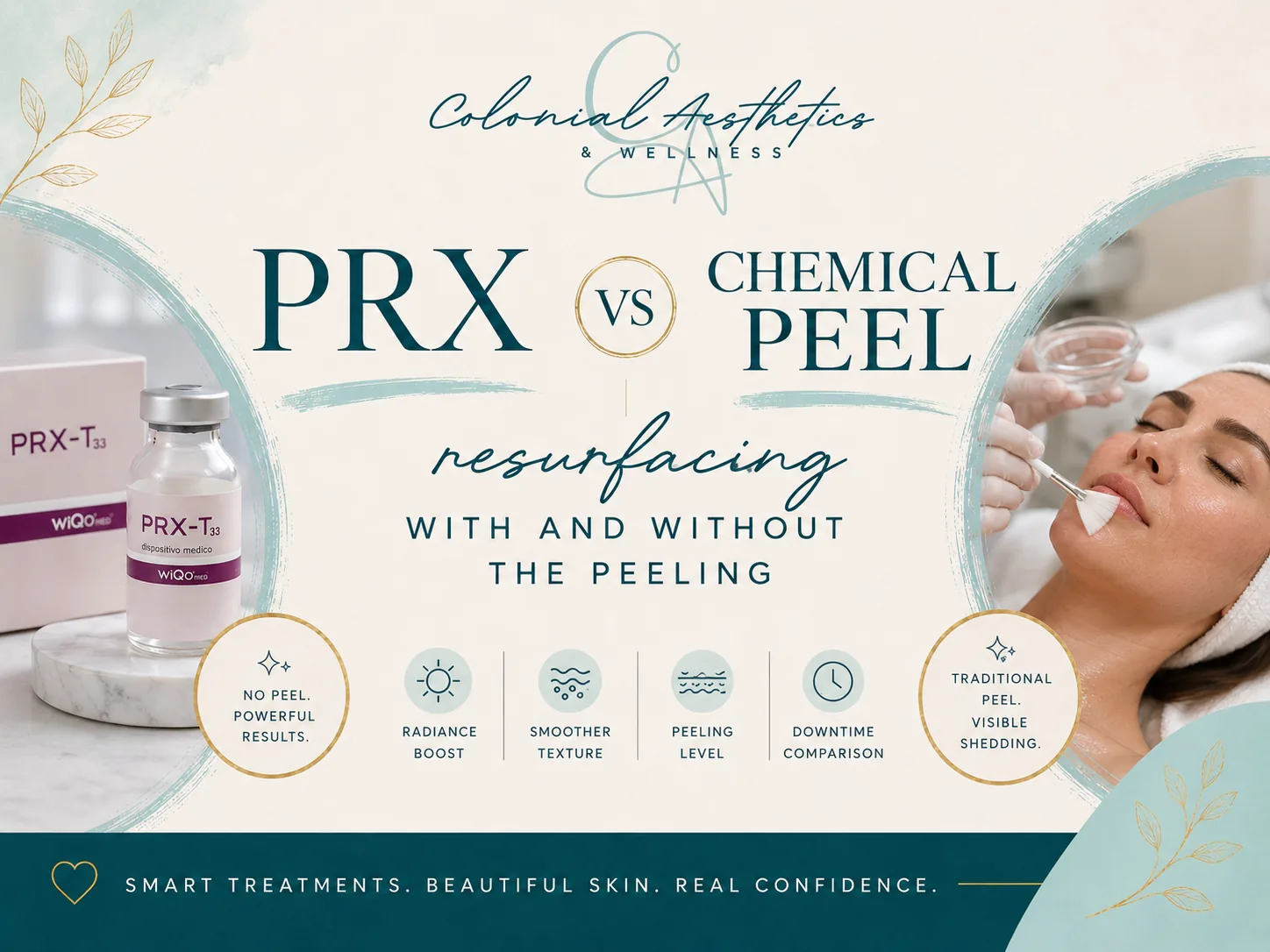
The short answer: a chemical peel loosens and sheds the surface layer of your skin to reveal newer skin underneath. PRX is a topical treatment massaged into the skin that works without visible peeling. If pigment and sun damage are your main concern and you can plan around a week of flaking, a medium-depth peel is the stronger instrument. If you cannot have visible downtime, PRX is the one.
Both live on our resurfacing menu at our Williamsburg, VA practice, and they suit different people for different reasons.
How does a chemical peel work?
A peel is a precisely formulated blend of acids applied to the skin. The acids loosen the bonds holding dead surface cells together so they shed, revealing newer skin beneath. Glycolic acid does this through a targeted effect on the junctions between cells rather than by damaging the skin barrier (Fartasch et al., Archives of Dermatological Research).
Depth is the entire vocabulary of peels, and understanding it is most of understanding the category.
Light peels work within the epidermis and shed over several days. Medium peels reach from the epidermis through the papillary dermis into the upper reticular dermis, with redness settling over one to two weeks. Deep peels reach the mid reticular dermis (StatPearls).
We run two systems with genuinely different downtime. BioRePeel resurfaces without visible peeling, which makes it a weekday treatment. VI Peel is a classic medium-depth peel with visible peeling for five to seven days, and it is the stronger option on sun damage, fine lines and melasma.
The American Academy of Dermatology lists what peels treat well: some types of acne, age spots, uneven tone, dull complexion, fine lines especially around the eyes and mouth, freckles, melasma, rough texture and sun-damaged skin (AAD).
Do peels work on deeper skin tones?
Yes, with the right depth, and matching depth to skin is exactly what a trained provider is for.
A 2026 review found superficial glycolic and salicylic acid peels show good safety profiles in deeper skin tones, and recommended mandelic acid at higher Fitzpatrick types for its more predictable penetration (Garelick et al., Cureus). The guidance is to favour superficial agents, control active acne or melasma before treating, and keep sun protection strict afterwards.
That is a workable plan rather than a closed door, and it is why we screen and choose rather than running one protocol for everyone.
How does PRX work?
PRX is a layered topical solution applied with a specific massage technique that drives it into the skin. It is formulated around trichloroacetic acid with hydrogen peroxide, and it is designed to work without ablating or shedding the surface.
The no-peeling part is its defining feature and it is well documented. In a clinical evaluation published in the Journal of Clinical and Aesthetic Dermatology, participants completed four sessions a week apart and every one showed improvement in skin tone, smoothness, texture and redness, with significant improvement recorded on each measure. Frosting and visible shedding of the epidermal layers did not occur, and the only effects reported were transient tingling and mild redness (Gold et al.).
Most people feel a mild tingling during application that fades before the session ends. Afterwards skin may feel slightly tight for a few hours, and that is the entire recovery. Results vary, and a series is how the effect builds.
We offer three protocols. Glow is the brightening-focused starting point. Plus is the stronger option with an extra session. Plus C adds vitamin C for unevenness and tone.
Side by side
| PRX | Chemical peel | |
|---|---|---|
| What it is | Topical TCA and hydrogen peroxide, massaged in | Acid blend that exfoliates the surface |
| Surface shedding | None, by design | Yes, to varying depth |
| Visible downtime | None, mild tightness for hours | None with BioRePeel; 5 to 7 days peeling with VI Peel |
| Session length | 30 to 45 minutes | 30 to 45 minutes |
| Typical plan | Series of 4 to 5, spaced 1 to 2 weeks | Series of 3 to 4, every 3 to 4 weeks |
| Strongest on | Overall skin quality, glow, tone | Pigment, sun damage, melasma, texture |
| Needles | None | None |
Both are priced by protocol and series. Current starting prices are on the PRX and chemical peels pages.
When do we reach for PRX?
- You cannot have visible downtime, and that constraint is genuine rather than a preference.
- Your skin is sensitive, or stronger protocols have been more than you wanted.
- The goal is overall skin quality and glow rather than clearing a specific patch of pigment.
- You want to keep resurfacing going through the warmer months.
When do we reach for a peel?
- Sun damage and pigment are the main event and you want them addressed directly.
- You have melasma, where medium-depth peels have a genuine track record.
- You want the most visible change in the shortest time and can clear a week.
- Texture and congestion need physical exfoliation rather than stimulation from underneath.
- You want to combine, since BioRePeel pairs well with microneedling on the face.
When is something else the better fit?
- When the concern is laxity. Neither tightens meaningfully. That is radiofrequency microneedling territory.
- When the concern is volume. Hollowing is loss rather than surface damage, and resurfacing does not replace it.
- When sun damage runs deeper than the surface. Significant photodamage often wants laser resurfacing, and we would rather say so than book four sessions that get you partway.
Tell us first if any of these apply
So we can pick the right depth and the right timing.
- Active irritation, sunburn, an open lesion or an infection in the area, which simply means we wait.
- A recent in-office resurfacing treatment, since spacing is part of the plan.
- Isotretinoin use now or recently. Current consensus finds no need to delay superficial peels, and medium and deep peels are timed more conservatively (Spring et al., JAMA Dermatology). We will ask and make the call with you.
- Pregnancy or breastfeeding, a history of cold sores, a keloid tendency, or a condition affecting wound healing.
A peel takes something away so new skin can arrive. PRX asks the skin you have to rebuild itself.
Do you have to choose?
Not permanently. Plenty of plans use peels in the cooler months when sun avoidance is easy, and PRX through the rest of the year to keep things moving without downtime.
Both depend on what happens at home. Resurfacing works best alongside daily SPF and a few well-chosen actives, and our skincare routine guide covers the version that holds up.
Book a consultation and we'll look at your skin and tell you which of these fits.