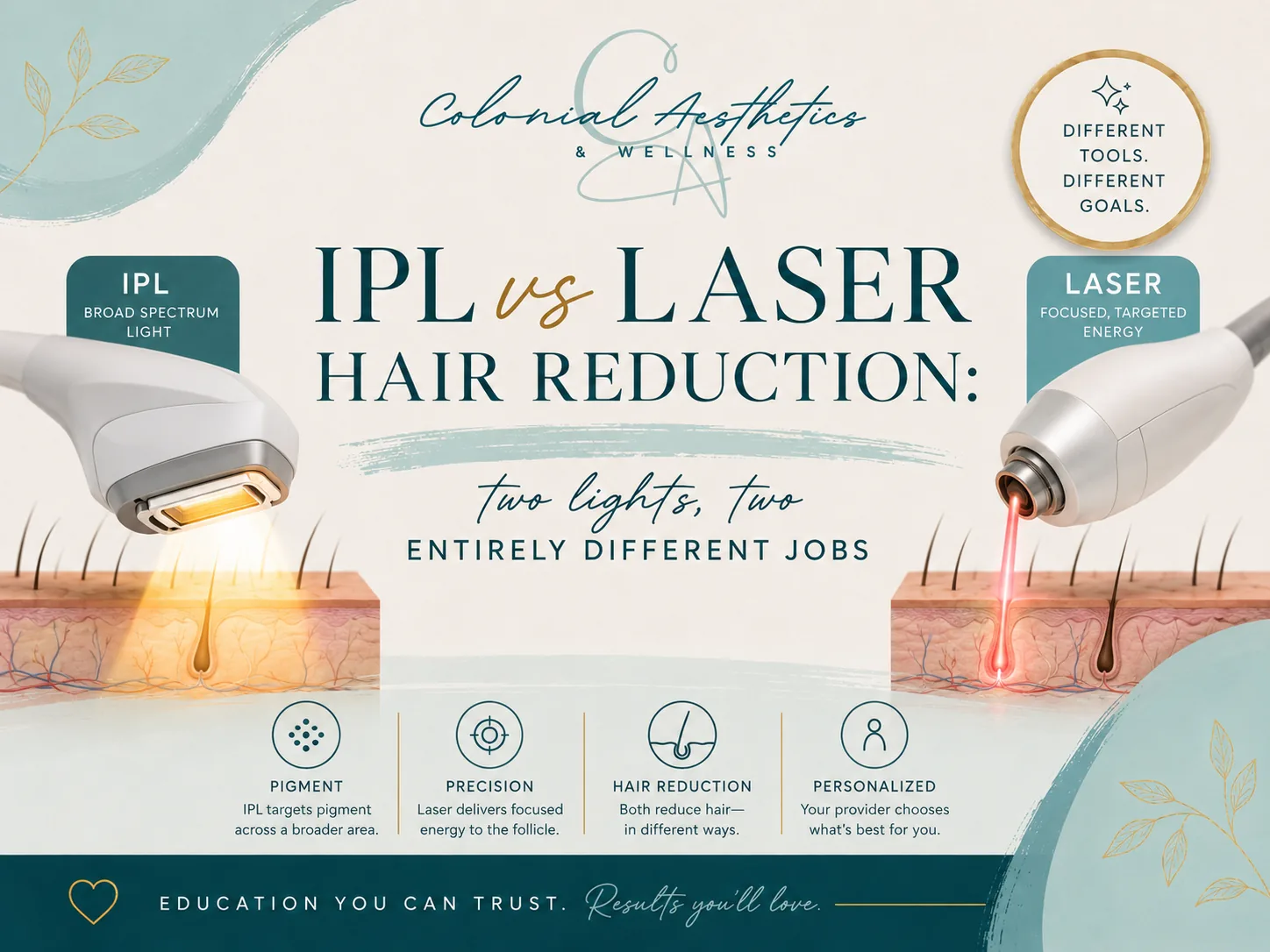
The short answer: IPL photofacial treats what is on your skin, meaning sun spots, age spots, broken capillaries and diffuse redness. Laser hair reduction treats what is growing out of it. They are not alternatives, and most people who want both book them separately.
The confusion is understandable. Both use light, both rely on pigment absorbing that light, and home IPL devices are marketed almost entirely for hair removal. The treatment we offer as IPL is a photofacial.
Why do people mix them up?
Both work by selective photothermolysis: deliver light at a wavelength a particular target absorbs more strongly than the surrounding tissue, and you heat that target precisely.
The difference is the light. IPL is a flashlamp producing broadband, non-coherent light across a wide range, roughly 500 to 1200 nanometres depending on the device and the filter fitted. That breadth is an advantage when you are treating several things at once across a whole face. Hair reduction lasers emit coherent light at a single wavelength, which is what lets them reach a specific depth with precision (StatPearls).
Same physics, different tool for a different job.
What does an IPL photofacial do?
It breaks up sun spots, age spots and broken capillaries. The light heats and fragments the pigment or the vessel, and your body clears the debris over the following days.
Expect the coffee-ground effect. Treated sun spots darken noticeably before flaking off over five to ten days. That is the treatment working, and we tell you beforehand because it surprises people who were not warned.
IPL is well established for this. It effectively addresses pigmented lesions such as age spots, vascular lesions including broken capillaries and rosacea, and photoaging, and the FDA has cleared IPL devices for more than a dozen dermatologic applications (StatPearls). For rosacea specifically, a meta-analysis found IPL effective with a slight advantage over pulsed dye laser in achieving substantial clearance.
Sessions run 30 to 45 minutes, spaced about four weeks apart, and a series of three is where most people see the full effect. You see improvement after each one.
Because IPL depends on pigment absorbing light, it suits lighter skin tones best. We assess your skin type at consultation and recommend the right route for you.
What does laser hair reduction achieve?
Lasting reduction in how much hair grows in the treated area, and for most people that means stepping out of the shaving and waxing cycle rather than never seeing another hair.
The published trials with long follow-up, meaning beyond a full hair growth cycle, consistently show meaningful long-term reduction across the laser platforms, with alexandrite and Nd:YAG performing strongest (Krasniqi et al., Journal of Cosmetic and Laser Therapy). Results are best on areas with longer hair growth cycles, such as the legs.
That review also found lasers outperform IPL for hair, which is why we use a dedicated laser rather than a photofacial device for this.
We call it reduction rather than removal on purpose, and so does the FDA-cleared terminology. The AAD notes it is permanent on most body areas, and that hormonally driven areas such as the face often benefit from occasional maintenance (AAD). Setting that expectation before the package is fairer than explaining it afterwards.
Which wavelength suits which skin tone?
This is the question that decides both safety and results, and it is the most useful thing on this page.
Nd:YAG at 1064 nm penetrates deeper and passes more easily through surface pigment, which is why it is the appropriate choice across the full range of skin tones (StatPearls). A systematic review of 13 trials and 734 patients found it safe and effective for hair reduction.
Matching the wavelength to your skin is the single most important decision in this treatment, and it is why we assess before we book.
Why does it take several sessions?
Because a follicle responds only while it is in its active growth phase, and follicles cycle out of step with one another. Each session catches a different portion.
The AAD's figure is 2 to 6 treatments spaced every 4 to 6 weeks, and it notes on its overview page that it can take 6 sessions or more (AAD). We sell packages of six because that matches what most areas need.
Sessions run 15 minutes for a lip to about an hour for full legs, with visible thinning usually appearing after the second or third.
Side by side
| IPL photofacial | Laser hair reduction | |
|---|---|---|
| Light source | Broadband intense pulsed light | Single-wavelength laser |
| Target | Pigment and vessels in the skin | Pigment in the hair follicle |
| Treats | Sun spots, age spots, broken capillaries, redness | Unwanted hair |
| Session length | 30 to 45 minutes | 15 to 60 minutes by area |
| Spacing | About 4 weeks | 4 to 6 weeks |
| Typical plan | Series of 3 | Package of 6 |
| What you see | Spots darken then flake over 5 to 10 days | Hair sheds gradually over 1 to 3 weeks |
| Skin tone | Best suited to lighter tones | Wavelength matched to your skin type |
| Season | Best in cooler months | Year-round with sun precautions |
Both are priced by area. Current starting prices are on the IPL photofacial and laser hair reduction pages.
What do they both need from you?
A settled, un-tanned baseline. A tan adds pigment to the skin that competes with the intended target, which makes treatment less effective.
The AAD advises avoiding direct sunlight and any tanning bed or sun lamp around treatment (AAD), and StatPearls calls strict sun protection and sunscreen a must before and after. So both want about two weeks with no sun and no self-tanner beforehand, no retinoids on the area for around five days, and diligent sunscreen afterwards.
For IPL we go further and suggest booking in fall, winter or early spring.
One difference on the day: shave the area 24 hours before laser hair reduction and do not wax or pluck, because the laser needs the follicle intact and the shaft present. IPL wants clean skin and no makeup.
Where is something else the better fit?
- When the pigment is melasma rather than sun damage. Melasma behaves differently and usually responds better to a peel or topical approach.
- When the concern is texture rather than tone.Resurfacing or microneedling is the right instrument.
- When the hair is unpigmented. Grey, white and very fine blonde hair contains little for a laser to target, and we will tell you that rather than sell a package.
- When hair growth is new or unexplained. A sudden change can have a hormonal driver worth investigating, and we run that side here too.
What we'll talk about at your consult
- Your skin type, and which wavelength we will use.
- Recent sun exposure, self-tanner, or a tan in progress.
- Any history of cold sores, so we can prescribe a preventive antiviral.
- Whether you are pregnant or breastfeeding.
- Current medications, including anything that increases light sensitivity.
- What a realistic result looks like for your hair colour and the area you want treated.
One clears what the sun left on your skin. The other reduces what keeps growing out of it.
Can you have both?
Yes, and plenty of people do. IPL on the face and chest for accumulated sun damage, laser hair reduction on underarms, legs or bikini. They are unrelated treatments on unrelated concerns.
The only coordination needed is on overlapping areas and on the calendar, since both want a settled baseline.
Book a consultation and we'll match the right wavelength to your skin and tell you what to expect.