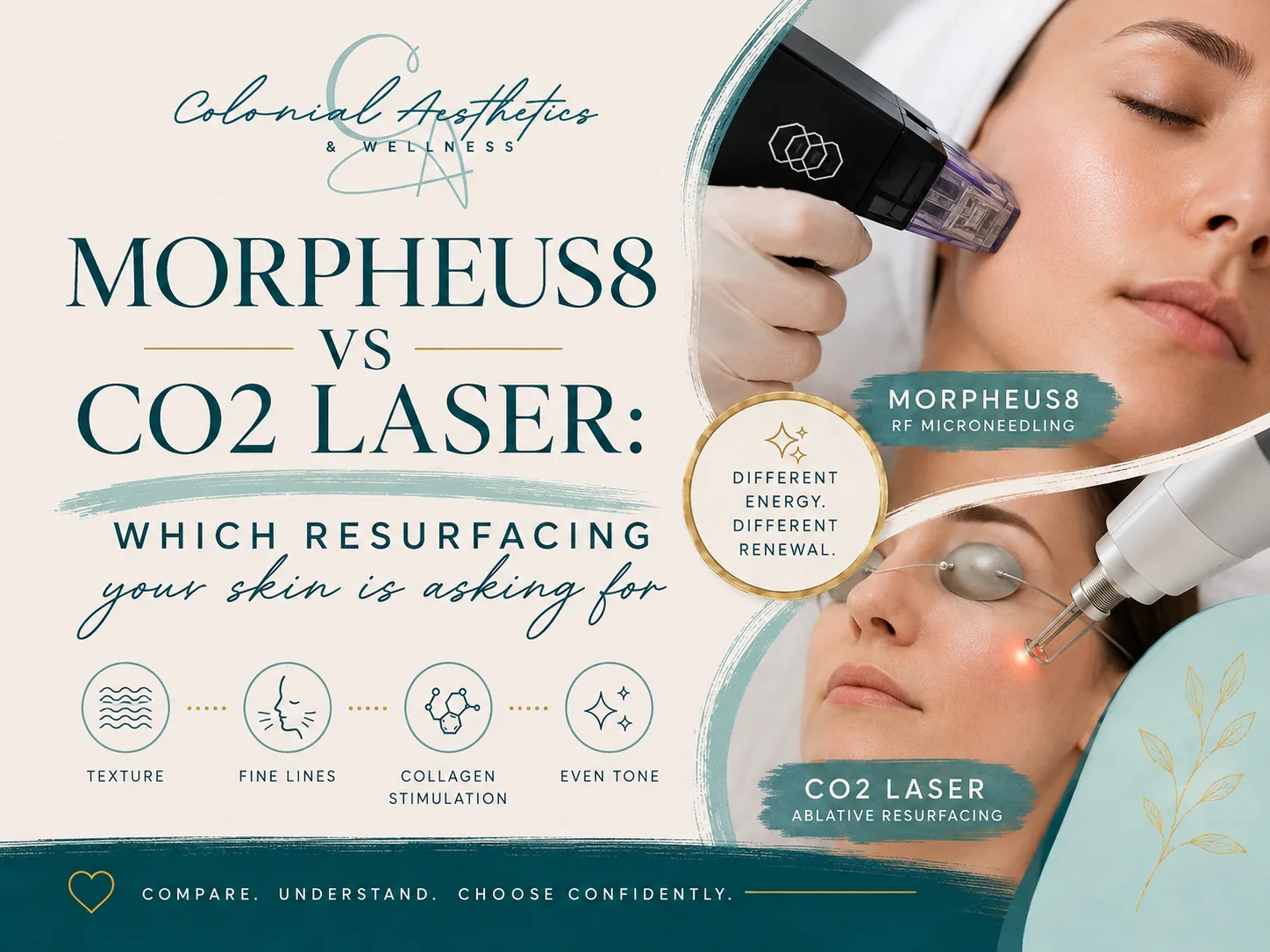
The short answer: Morpheus8 is for laxity. It heats the deeper layers with radiofrequency and remodels them, leaving the surface intact, and it suits a wide range of skin tones. CO2 laser is for the surface. It resurfaces damaged skin to treat texture, sun damage, fine lines and tone. If your concern is a jawline that has softened, start with Morpheus8. If it is sun damage and etched lines, start with CO2.
If it is both, read on, because the sequencing matters.
How does Morpheus8 work?
Morpheus8 combines microneedling with radiofrequency energy. The needles create microchannels, and radiofrequency is delivered through them into deeper tissue, where controlled heat triggers collagen remodelling at a depth ordinary microneedling cannot reach. The surface is never removed.
The mechanism difference from a laser is worth understanding. Radiofrequency is not chromophore-dependent, meaning it does not rely on being absorbed by a specific target such as pigment, and the epidermis takes minimal impact as a result (Malarz et al., Frontiers in Medicine). Microneedle radiofrequency devices work at depths from about 0.5 to 4.5 mm depending on the area, with collagen remodelling following over three to six months.
The same device treats face and body at different depths: shallower around the eyes and under the chin, deeper for laxity on the abdomen or thighs. Sessions run 45 to 60 minutes per area, and our standard plan is a series of three.
How does CO2 resurfacing work?
CO2 laser is ablative. Its 10,600 nm light is absorbed by water in the tissue, resurfacing damaged skin in a fractional pattern and triggering collagen renewal underneath (StatPearls). Because it actually resurfaces rather than heating from within, it does things to tone and texture that no non-ablative device matches.
We run it at two intensities, and they are genuinely different commitments.
CoolPeel is the lighter protocol: a series of three, spaced four to six weeks apart, with one to two days of pinkness and mild flaking per session. It runs on the DEKA SmartXide platform, which is FDA-cleared (510(k) K240497). The short pulse is what keeps recovery brief.
Fractional ablative is a deeper single session done every six to twelve months. StatPearls puts recovery at four to ten days before returning to work, and it produces the biggest single-treatment change on our menu.
What happened when they were compared directly?
Someone ran the comparison, in the skin types where the question matters most, and the result is genuinely useful.
A randomized split-face trial treated 30 patients with facial acne scarring, Fitzpatrick types III and IV, with radiofrequency microneedling on one side and fractional CO2 on the other (Le et al., Acta Dermato-Venereologica). Scar improvement was statistically indistinguishable between the two, around 30% by six months on both sides. The recovery was not close.
That is the honest shape of the comparison. Not that one works better, but that for acne scarring in skin types III and IV, Morpheus8 got to the same place with less to plan around.
Which suits deeper skin tones?
Radiofrequency has a well-documented advantage here. A review of 35 studies in skin of color concluded that radiofrequency and radiofrequency microneedling carry low risk of scarring or hyperpigmentation (Syder et al., Dermatologic Surgery). Because it does not depend on pigment absorbing energy, settings translate more predictably across skin tones.
CO2 can still be an excellent choice, and it is chosen with more care. A cohort study of fractional CO2 using a short-pulse mode in Fitzpatrick types I through IV reported no documented hyperpigmentation and no blistering, with redness resolving within 72 hours in half of patients (Oloruntoba and Rodrigues, Journal of Cosmetic Dermatology).
We assess your skin type at consultation and set depth and energy accordingly. That adjustment is a real part of the work, and it is the reason we ask.
Side by side
| Morpheus8 | CO2 laser resurfacing | |
|---|---|---|
| Energy | Radiofrequency through microneedles | Ablative laser light, absorbed by water |
| Works on | Deep layers, surface left intact | Surface resurfaced, renewal underneath |
| Best at | Laxity, jawline, deeper scarring, stretch marks | Sun damage, tone, texture, fine lines |
| Downtime | 2 to 4 days typically | 1 to 2 days per CoolPeel session; 4 to 10 days for fractional |
| Typical plan | Series of 3, annual maintenance | CoolPeel series of 3; fractional every 6 to 12 months |
| Results build | Over 3 to 6 months | Continue improving for months |
| Deeper skin tones | Settings translate predictably | Chosen with more care, excellent in the right candidate |
| Body as well as face | Yes, at different depths | Face, neck and chest |
Both are priced per area and by plan. Current starting prices are on the Morpheus8 and CO2 laser pages. For the full first week after Morpheus8, we wrote a separate aftercare guide.
When do we reach for Morpheus8?
- Softening along the jawline or under the chin, the concern it was built for.
- Mild to moderate laxity anywhere, face or body.
- Deeper acne scarring and stretch marks, where the problem sits below the surface.
- Deeper skin tones, where its mechanism translates predictably.
- Anyone who can absorb a few days of looking like they have had something done but not a week of visible healing.
When do we reach for CO2?
- Cumulative sun damage, uneven tone and the crepey texture that comes with it.
- Fine lines etched into the surface rather than produced by movement.
- Overall dullness where the goal is a genuine step-change in skin quality.
- Anyone who wants the biggest single-treatment change and can plan around the recovery.
- Cooler months, since a settled, un-tanned baseline is part of a good outcome.
When is something else the better fit?
- When the concern is volume, not surface or laxity. A face that has deflated reads as a face that has sagged. Filler or a biostimulator is the tool.
- When it is early days. Mild texture and first fine lines often respond well to microneedling or a peel at a fraction of the cost and downtime.
- When the laxity is advanced. Morpheus8 is a real tightening treatment and it is not a facelift. If the result you describe is surgical, we will say so.
What we'll talk about at your consult
- Your skin type and how we will set depth and energy for it.
- Any recent sun exposure or tan, since both treatments want a settled baseline.
- Any history of cold sores, so we can prescribe a preventive antiviral beforehand.
- Recent isotretinoin use. Current consensus finds no need to delay fractional procedures, and fully ablative resurfacing is timed more conservatively (Spring et al., JAMA Dermatology).
- Active infection or breakout in the area, which simply means we wait.
- The week you can actually clear, which decides more than anything else.
Morpheus8 changes the structure under your skin. CO2 changes the skin itself. Most of the decision is in that sentence.
Can you do both?
Yes, and for the right person it is the strongest plan available. They address different layers, so they compound rather than overlap.
What they cannot do is share a calendar. Both prompt a healing response, so we space them deliberately and usually lead with whichever concern bothers you most.
Book a consultation and we'll look at your skin together, talk through downtime and skin type, and tell you honestly where to start.