
The short answer: after Morpheus8 at our Williamsburg, VA practice, your skin looks and feels sunburned for 24 to 72 hours, then turns dry and faintly gridded for three to seven days. Light mineral makeup is fine after 48 hours. Most people are back to normal life in two to four days, and results build over three to six months.
This is the aftercare we give every patient, with the timeline behind each step. It complements rather than replaces the instructions you receive at your visit.
What's happening in your skin?
Morpheus8 delivers radiofrequency heat through fine insulated needles that reach up to 4 mm into facial skin. The FDA cleared the current applicator in June 2024 for dermatologic procedures where coagulation or contraction of soft tissue is needed (FDA 510(k) K240017).
In plain terms, it creates thousands of tiny, controlled points of thermal stimulation, and your skin's repair response is what tightens and smooths it. Pinpoint bleeding and swelling at the end of treatment are the intended endpoints (Shauly et al., Aesthetic Surgery Journal Open Forum).
The collagen work happens later and gradually. A 247-patient series found the deeper skin layer actively rebuilding collagen by ten weeks (Dayan et al., Aesthetic Surgery Journal), and a critical review in Dermatologic Surgery reported improvement continuing past six months (Tan et al.).
So the first week is about protecting a healing surface. It is not the week you judge your result.
How long is the downtime?
Two to four days for most face treatments in our practice, with a published range of one to seven days. What moves you along that range is how the treatment was set: needle depth, energy, which tip we use, how many passes, the area treated, and your skin type.
A 2026 pilot study treated 25 necks with Morpheus8 at 2 to 3 mm (Chawvavanich et al., Journal of Cosmetic Dermatology). Redness resolved within 24 to 48 hours. Small scabs, where they occurred, cleared in three to five days. No one developed lasting dark spots.
Cleveland Clinic describes skin after radiofrequency microneedling as mildly red for around 24 hours at typical settings (Cleveland Clinic), and the American Academy of Dermatology says microneedling reactions usually resolve in a few days to a week (AAD).
The skin around the eyes swells a little more. Neck and body skin takes slightly longer. If you have an event, book ten days ahead so the flaking stage is comfortably behind you.
| Window | What you will likely notice | What to do |
|---|---|---|
| Hours 0 to 2 | Heat, tightness, pink to red skin | Cool compress through a clean cloth |
| Hours 2 to 24 | Sunburn feel, swelling starts | Bland emollient; sleep with head raised; no makeup or workouts |
| Day 2 | Swelling most noticeable, first roughness | Gentle cleanser, emollient, mineral SPF once skin is closed; mineral makeup from hour 48 |
| Day 3 | Sandpaper texture, faint grid marks | Same routine; light exercise once nothing is hot |
| Days 4 to 5 | Flaking, grid marks fading | Full workouts; keep skin covered outdoors |
| Days 6 to 7 | Skin looks normal to most people | Restart gentle actives on the timing below |
What should you do in the first 24 hours?
Keep it cool, covered and untouched. The numbing wears off over the first hour or two and the skin feels like a strong sunburn. A cool compress through a clean cloth helps.
For the rest of day one:
- Emollient only. Apply the post-care balm we send home, or plain petroleum jelly, in a thin layer. Peri-procedure wound care guidance favours bland ointments for this window (Lynde et al., Skin Therapy Letter).
- Sleep with your head raised for the first two to three nights. Shauly et al. recommend 48 to 72 hours of head elevation to limit swelling.
- No makeup, no sweat, no heat. Skip workouts, saunas and hot water on the face for at least 48 hours, and longer if you are still pink.
- Cleanse gently that evening, or wait until morning. Cool water, fingertips, a fragrance-free cleanser, pat dry.
Acetaminophen is fine if you want it. Most people do not need anything.
Days 2 and 3
Day two is usually when you look the most treated, and that is expected. Swelling commonly builds overnight and settles over two to three days (Gowda et al., JCAD). A little itching is normal and passes within a few days.
Your routine now is a gentle cleanser twice a day, emollient whenever skin feels tight, and sunscreen. Once the surface is closed, usually by day two, switch to a mineral SPF 30 or higher that is broad-spectrum and water resistant. Use about a teaspoon for the face and reapply every two hours outdoors (AAD).
Mineral makeup is fine from hour 48. The AAD's floor is 24 hours and Shauly et al. suggest 24 to 48; we ask for the longer end so the micro-channels are fully closed.
Let the grid marks flake on their own rather than helping them along.
Days 4 through 7
By day four the swelling is gone and the grid marks are fading into flaking. Full workouts are fine once nothing is hot, which for most people is day three to five. Pools and hot tubs wait until the skin is fully intact, usually a week.
Actives come back in order. This is our protocol, set to give your skin barrier time to recover fully:
- Day 5: vitamin C, if it does not sting.
- Day 7: glycolic, lactic or salicylic acid, on alternating nights.
- Days 7 to 10: retinoids, starting at two nights a week.
Go back a step if anything feels uncomfortable. Sun protection is stricter than exercise: Shauly et al. recommend avoiding sun exposure for two weeks, and the AAD lists sun protection as the most important step for keeping results. A skincare routine that holds up matters more after Morpheus8 than before it.
Morpheus8 does its work over months. The first week only decides whether it gets a clean start.
When should you call us?
Recovery is usually uneventful, and we would always rather hear from you than have you wonder. Call or text the same day if you notice:
- Tingling or itching in one spot followed by clustered blisters, which can be a cold-sore flare. Tell us at booking if you have a history so we can prescribe a preventive antiviral in advance (Vaghela et al., JCAD).
- Spreading redness, warmth or pain that increases after day three.
- Swelling that lasts beyond a week, or a firm area under the skin.
- Darkening that is still there two weeks out.
There are also reasons to postpone treatment in the first place: an active tan or sunburn, a skin infection, or isotretinoin in the past month (AAD). An active cold sore belongs on that list too.
Does aftercare change for deeper skin tones?
Slightly, and mostly in how the treatment is set rather than what you do afterwards.
We adjust energy and depth by skin type, which is standard practice and well supported. A 2022 review of Morpheus8 facial protocols advises lowering energy at shallow depths in deeper skin tones (Hendricks and Farhang, Journal of Cosmetic Dermatology). Done that way, the record is reassuring: a review of 35 studies in skin of color concluded the risk of scarring or lasting pigment change is low (Syder et al., Dermatologic Surgery).
On aftercare, sun protection is the one place to be stricter. Deeper skin often shows the first days as darker patches rather than pink. A tinted sunscreen with iron oxides, which blocks visible light as well as UV, is the better choice for anyone prone to pigment change (Zhou et al., International Journal of Dermatology). We recommend it for the full two weeks, and after that as well.
When will you see results?
Three to six months, with a series. Our standard Morpheus8 plan is three sessions spaced four to six weeks apart, then one maintenance session a year. Published studies have used one to four sessions spaced three to twelve weeks apart (Dayan et al.).
Results vary with depth, area and how consistently you protect the skin afterward. Current starting prices are on the Morpheus8 page; your plan is confirmed at consultation.
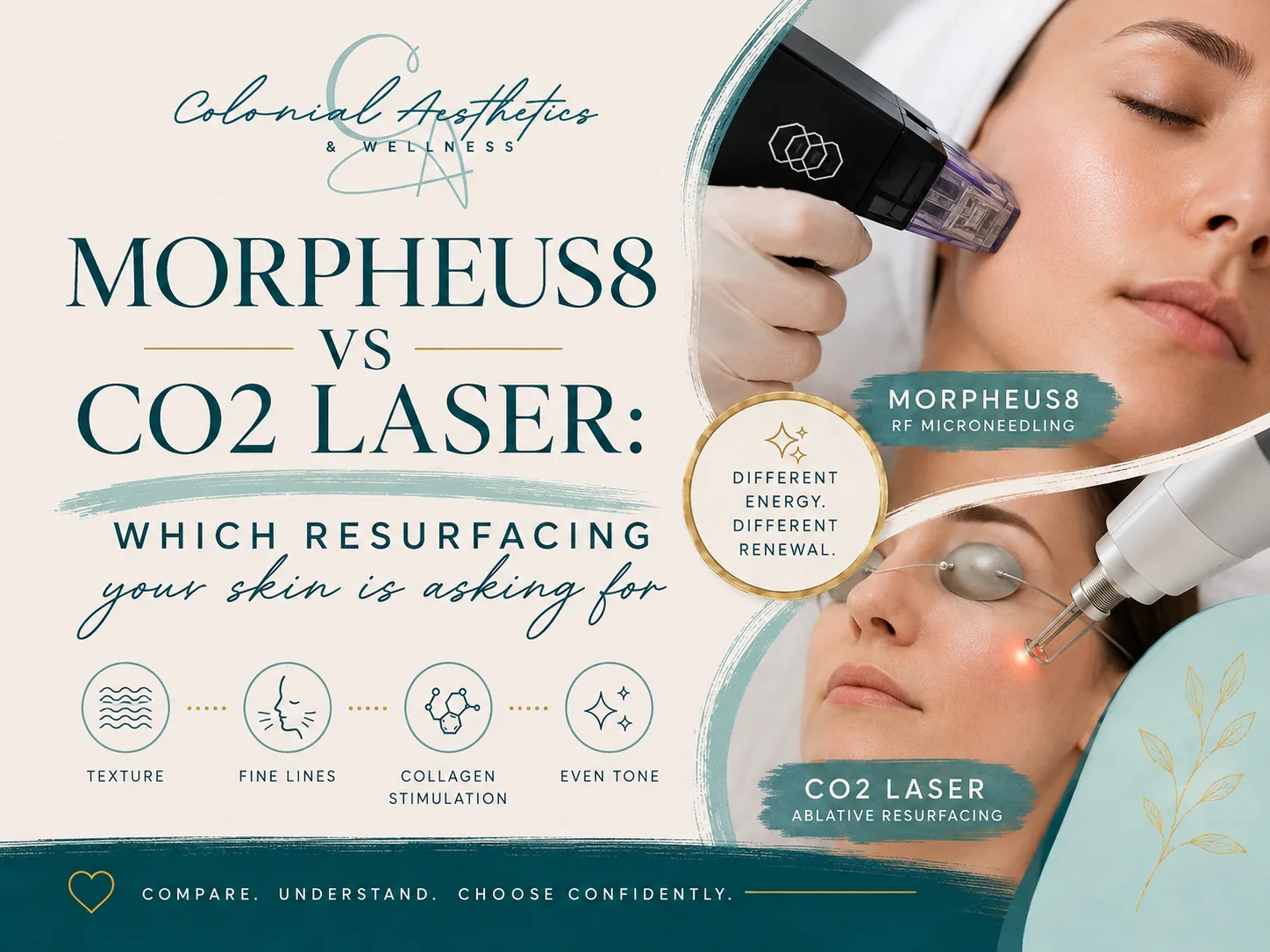
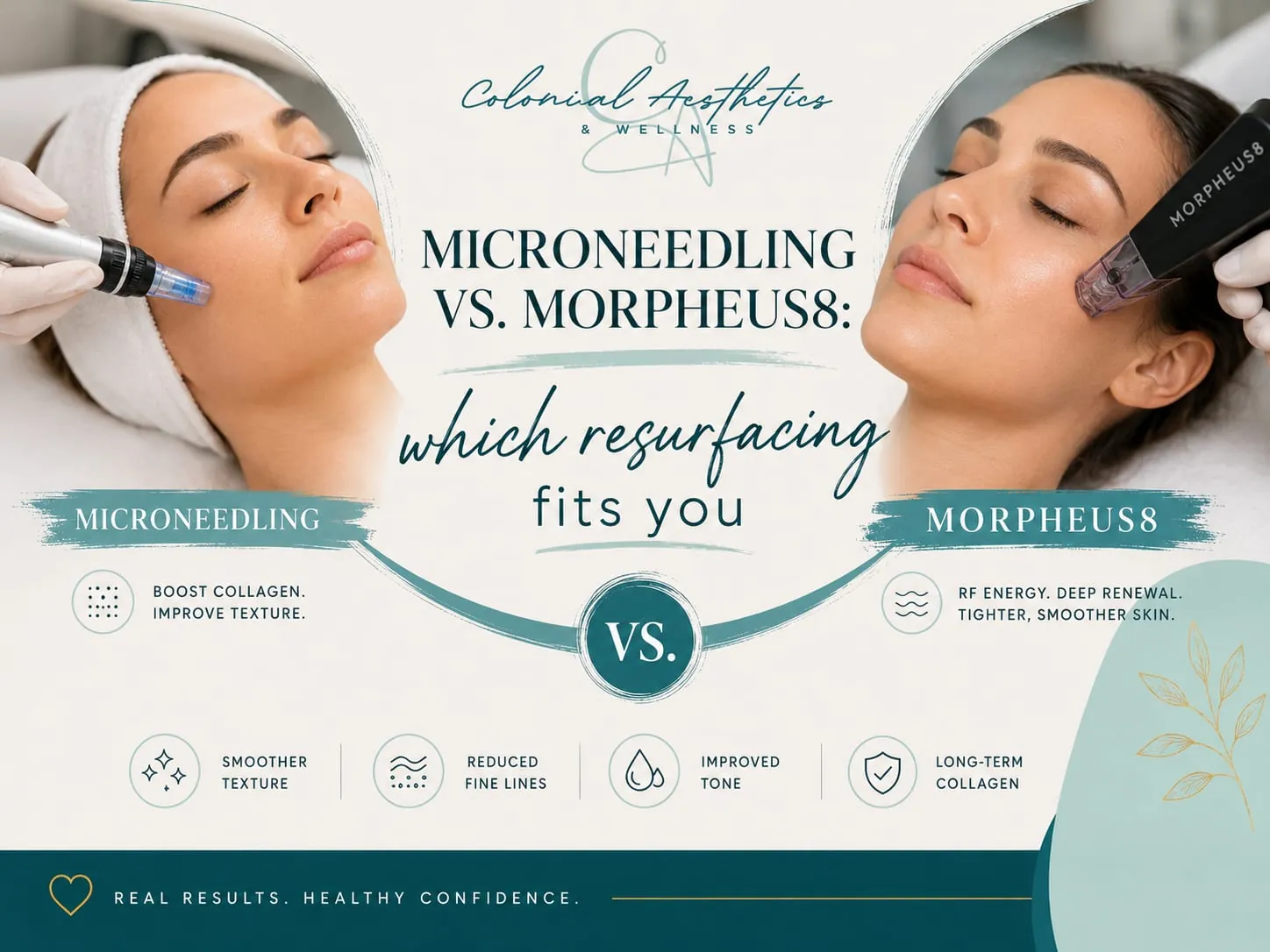
Still deciding? Our posts on Morpheus8 versus CO2 laser and microneedling versus Morpheus8 cover who each one fits.
Book a consultation and we'll look at your skin together and tell you honestly whether Morpheus8 fits your goals.