
IPL Photofacial.
Clear sun damage, redness, and uneven tone in a single afternoon. Broadband light absorbed by sun spots and broken capillaries — your body clears the rest.
No obligation · you're not charged for a consult that doesn't lead to treatment
Flexible monthly payments available with Cherry or PatientFi.
30–45 minutes
Sun spots darken 5–10 days · then flake off
Visible after each session · series of 3 ideal
Sessions 4 weeks apart
What it actually does.
IPL (Intense Pulsed Light) uses broadband light tuned to be absorbed by pigment (melanin) and hemoglobin (blood). The light energy heats and breaks up sun spots, age spots, and broken capillaries. Your body's own clearance system carries the debris away over the following days.
After IPL, you'll see a 'coffee ground' effect — sun spots darken before flaking off over 5–10 days. This is the point of the treatment, not a side effect. We tell clients this up front because it surprises people who weren't expecting it.
Skin-tone safety: IPL relies on light targeting pigment. That makes it well-suited to clients with lighter skin tones (Fitzpatrick I–III) and risky for darker skin tones, where the surrounding skin pigment can absorb the light too. We screen carefully and offer alternatives where appropriate.
IPL is best done in the cooler months. Active sun before or after the treatment is the single most common cause of post-IPL complications.
What to expect.
Before
No sun, no self-tanner for 2 weeks prior. Skip retinoids on the area for 5 days. Come without makeup. Bring sunglasses.
During
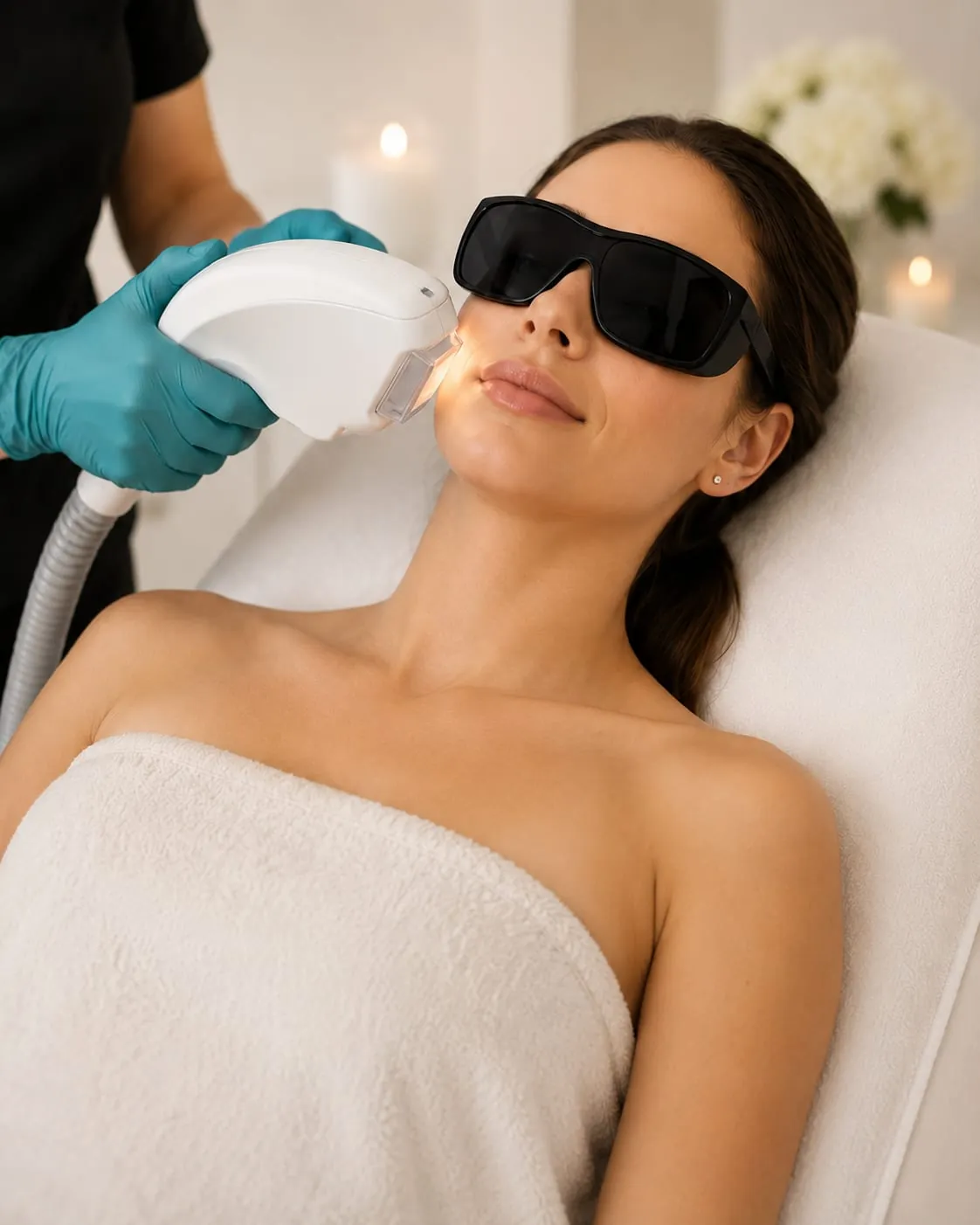
We apply cooling gel, you'll wear shielded eyewear, and we deliver brief pulses of light across the area. Each pulse feels like a quick rubber-band snap or a tiny burst of warmth. Treatment is 30–45 minutes.
After
Skin is briefly pink, then settles within hours. Over 5–10 days, sun spots darken ('coffee ground') and flake off. Do not pick. Sunscreen religiously — IPL'd skin is sensitized for weeks.
Who it's for
Who it's for.
- Fitzpatrick I–III skin tones
- Sun damage, age spots, freckling
- Broken capillaries and small facial veins
- Rosacea-related redness
- Uneven tone overall
Who should hold off or check with us.
- Darker Fitzpatrick skin tones (IV–VI) — risk of pigment complications
- Recent sun exposure or active tan
- Pregnancy
- Photosensitizing medications
- Recent isotretinoin (Accutane)
- Active cold sores, infections, or rashes in the area
If you're unsure, ask us — we'll go through your history during your consult.
Treatments that pair well with this one.
Questions clients ask us most.
Further reading
Medically reviewed by Brittany Ptachick, MSN, FNP-C and Catherine White, MSN, FNP-C
Board-certified Family Nurse Practitioners · Colonial Aesthetics & Wellness
Ready to talk through it?
We'll do a quick skin assessment first — sun history, current tone, what you're treating — before booking your session.
Book an AppointmentNo obligation · you're not charged for a consult that doesn't lead to treatment
Flexible monthly payments available with Cherry or PatientFi.or text us at 757-585-4647