
The short answer: ask who is performing your treatment and what their license is, ask how the practice handles a complication, and verify credentials yourself. Every credential worth having can be checked free online in about four minutes, and this page shows you exactly where.
"Med spa" is not a protected term, so the useful question is not which practice has the nicest interior. It is what to ask before you book. These are the eight questions we would want a member of our own family to ask, here or anywhere.
1. Who is performing the treatment?
Ask for the specific license of the person treating you, not the job title on the website. "Nurse injector" is a marketing phrase rather than a credential, and it covers several different levels of training.
In Virginia, registered nurses, nurse practitioners, physician assistants and physicians work under different scopes, with different authority to assess and prescribe. A nurse practitioner can evaluate you, diagnose and build a plan. A registered nurse works under an order from someone who can. Both can be excellent; knowing which you are getting is the point.
Virginia allows nurse practitioners to practise autonomously after the equivalent of three years of full-time clinical experience, with the regulation defining full-time as 1,800 hours a year (18VAC90-30-86, Code of Virginia § 54.1-2957). It is a fair question to ask where your provider sits.
Ask also who treats you at the follow-up, since in some practices that is a different person.
2. Can you verify their credentials yourself?
Yes, all of them, free, in about four minutes. Almost nobody does this, and it is the highest-value thing on this page.
| What to check | Who issues it | Where to verify |
|---|---|---|
| Virginia license, any health professional | Virginia Department of Health Professions | dhp.virginiainteractive.org/lookup |
| Nurse practitioner certification, FNP-C | AANPCB | aanpcert.org |
| Nurse practitioner certification, FNP-BC | ANCC | nursingworld.org |
| Physician board certification, any specialty | ABMS | certificationmatters.org |
| Plastic surgeon specifically | American Board of Plastic Surgery | abplasticsurgery.org |
Two things worth knowing while you are there.
FNP-C and FNP-BC are equivalent. They are family nurse practitioner board certifications from two different accredited bodies, and the suffix tells you which body rather than which rank. Both are valid for five years.
The terms aesthetic, cosmetic and plastic surgeon are not legally restricted (ASPS). So the meaningful question is which board certified them. Watch the acronyms: the American Board of Plastic Surgery is a different organisation from the similarly named American Board of Physician Specialties.
3. How does the practice handle oversight?
Ask who is responsible for the clinical standard, and how often they are present.
Virginia regulates laser hair removal by name. It must be performed by a properly trained physician, physician assistant or advanced practice nurse, or by a properly trained person under their direction and supervision (§ 54.1-2973.1). The training rules specify five curriculum areas and a minimum of ten proctored patient cases with demonstrated competency across skin types (18VAC85-20-91).
That is a concrete standard, and asking whether a practice meets it tells you something useful.
4. What happens if there is a complication?
This is the most revealing question on the list, and almost nobody asks it. A practice that has thought about it answers immediately and specifically.
Three things worth asking:
- Do you keep hyaluronidase on site? It is the enzyme that dissolves hyaluronic acid filler, and a 2024 review notes it acts within about 24 to 48 hours (Kroumpouzos and Treacy, JMIR Dermatology). "It is in the drawer" is the answer you want.
- What is your protocol? Any practice injecting filler should be able to describe what it watches for and what it does. The FDA advises working with a provider experienced in injecting fillers and knowledgeable about anatomy and managing complications (FDA).
- Who do I reach after hours? Ask whether that is a clinician or an answering service.
Complications are uncommon. The answer to this question still tells you how seriously a practice takes the medical half of "medical spa."
5. Where does the product come from?
Ask, and expect a straight answer.
The FDA advises against buying dermal fillers sold directly to the public, and against needle-free injection pens (FDA). Product bought through legitimate distribution, stored correctly and administered by a licensed clinician is the baseline you should expect, and any practice should be happy to confirm it.
6. Can they look past the surface?
A good deal of what brings people in is not primarily a skin problem. Hair thinning, skin that changed suddenly, weight that will not move, fatigue that reads on your face. These frequently have drivers underneath: thyroid function, iron, perimenopause, a medication, sleep.
Ask whether they can investigate causes, whether they order labs, and what they do when an aesthetic concern turns out to be a symptom. Our posts on hormone therapy and medical weight loss are examples of what that looks like in practice.
7. How do they decide what you need, and what does it cost?
There are two models. In the first, you arrive knowing what you want, order it from a menu, and receive it. In the second, you are assessed and a plan is proposed, which may not be the thing you came in for.
Ask whether the consultation is a genuine assessment or a booking step. The menu model is faster, and it is how someone ends up with filler in a face that needed resurfacing.
On price, the units are where the confusion lives.
- Neuromodulators are priced per unit. A per-unit price tells you nothing until you know how many units your anatomy needs. Ours start at $13 per unit.
- Filler is priced per syringe and biostimulators per vial. Ask how many the plan anticipates. Our tox and filler explainer covers why the units differ.
- Packages usually exclude something. Consultation fees, numbing, follow-ups and touch-ups are the usual candidates.
- Ask about the second year. Most aesthetic results are maintained rather than achieved once.
8. What happens when you are not a candidate?
Ask directly: what do you do when someone wants a treatment that will not give them what they are after?
The answer tells you most of what you need to know. The practices that mean it can give you an example without pausing, and can describe the last time they referred someone to a plastic surgeon instead of booking them. We wrote about where that line falls separately.
The AAD's own suggested questions run in the same direction: ask about board certification, experience with the specific procedure, and how often they treat patients with your skin tone and age range (AAD).
Every credential worth having can be checked in four minutes. The practices worth choosing will tell you where to look.
About this practice
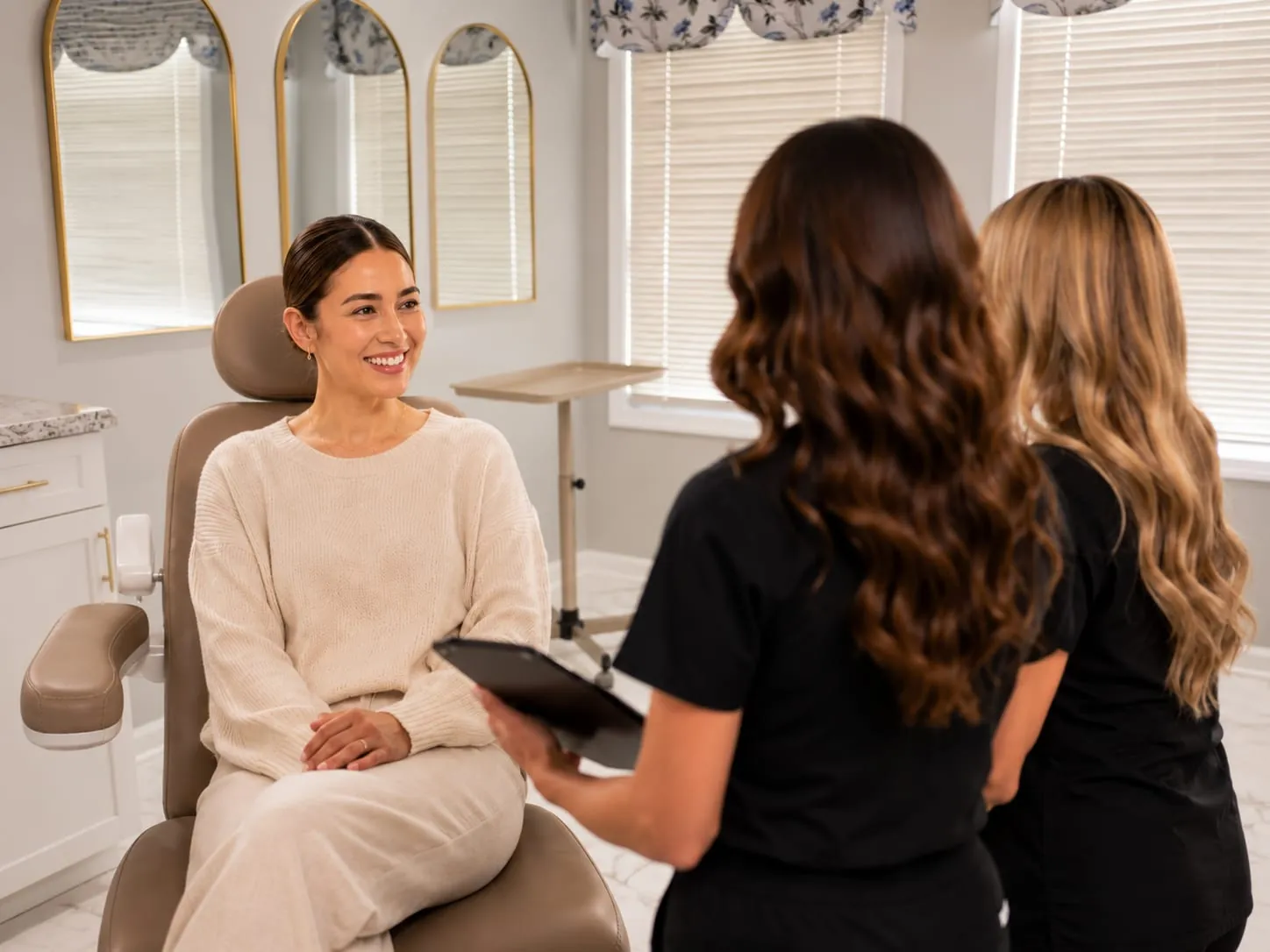
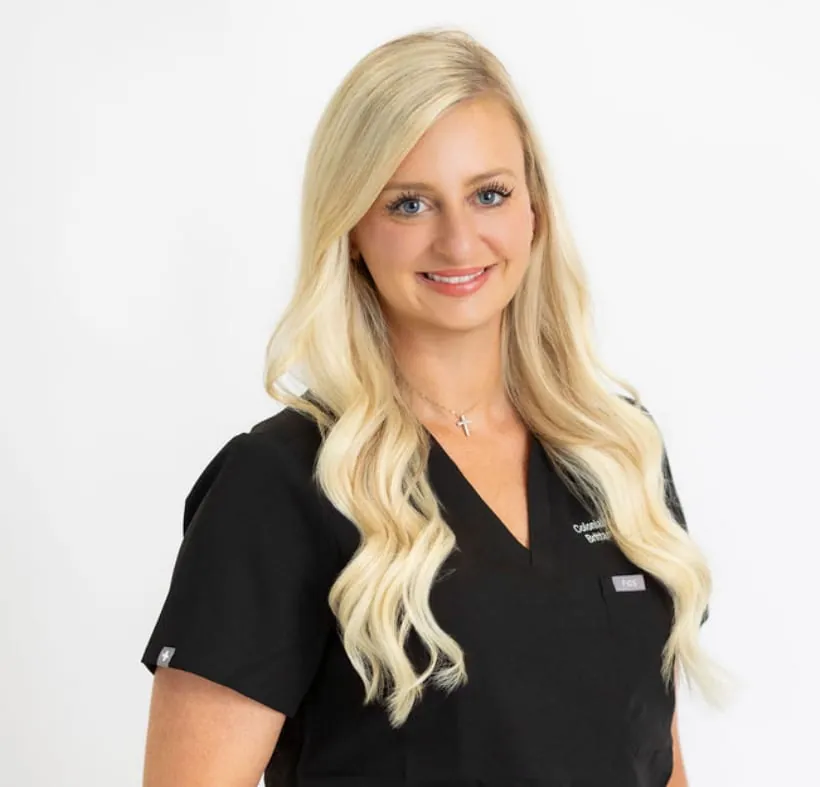
Colonial Aesthetics & Wellness is on Jamestown Road in Williamsburg. It was founded and is run by two board-certified Family Nurse Practitioners, Brittany Ptachick, MSN, FNP-C and Catherine White, MSN, FNP-C, and the person who assesses you is the person who treats you.
Both licenses are verifiable at the Virginia Department of Health Professions link in the table above, and we would rather you checked.
We offer aesthetic treatment and functional medicine in the same practice, which means an aesthetic concern with a medical driver can be investigated rather than covered. Consultation comes first, and it sometimes ends without a booking.
We would rather you asked us all eight of these questions than none of them.