
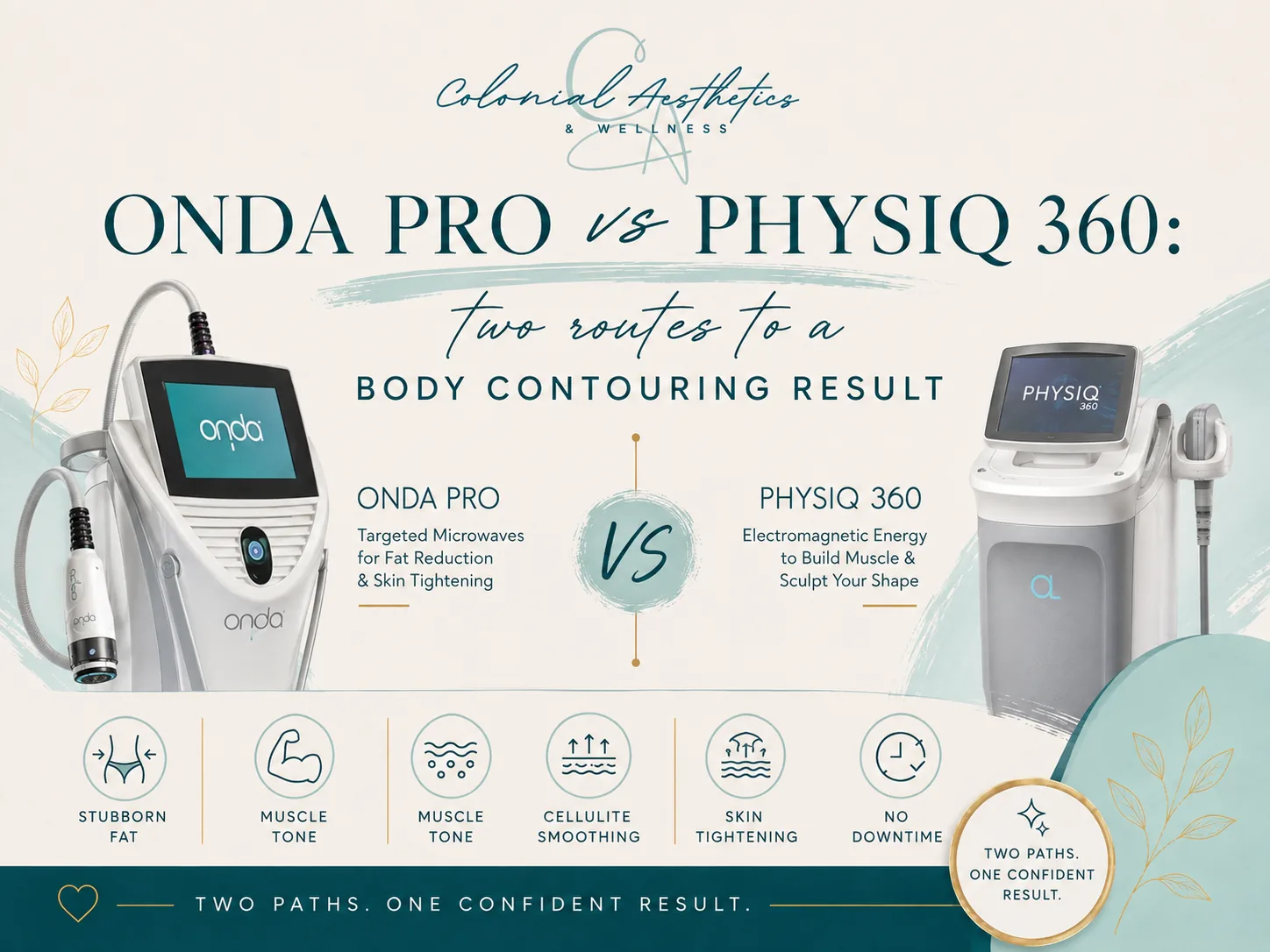
The short answer: Onda Pro is the one to pick when the skin over the area is part of the picture, because its microwave energy reaches fat and connective tissue. PhysiQ 360 is the one to pick when the area is soft rather than loose, because it pairs a fat-reducing laser with muscle stimulation in the same session.
Said another way: Onda works downward from the skin. PhysiQ works upward from the muscle. Both meet at the fat in between.
What do they have in common?
Both are entirely non-invasive, both have no downtime, and both are delivered as a series rather than a single dramatic session. You can have either on a weekday and carry on with your day.
Both are also area treatments rather than weight-loss treatments, and that distinction is what makes them work well. The American Society of Plastic Surgeons describes non-surgical fat reduction as an option for refining a defined area, and notes results are best in people at or near their goal weight (ASPS).
If weight loss is the goal, that is a medical weight loss conversation first and contouring afterwards. Doing it in that order means the shape you pay to refine is the shape you keep.
What is PhysiQ 360 designed to do?
PhysiQ 360 received FDA clearance in September 2023 for non-invasive lipolysis, meaning fat reduction, of the abdomen, flanks, back and thighs in individuals with a body mass index of 30 or less (FDA 510(k) K231971). The technology in that clearance is a 1060 nanometre diode laser.
That BMI figure is useful rather than restrictive. It tells you precisely who the device was designed and tested for, which makes it one of the clearest candidacy guides in the whole category. If you are in that range and want a defined area refined, you are exactly who it is for.
Alongside the laser, PhysiQ delivers electrical muscle stimulation, producing deep contractions of a kind you cannot reproduce voluntarily. Muscle stimulation devices of this class are cleared for purposes including muscle re-education, preventing disuse atrophy and increasing local blood circulation (FDA guidance).
Running both in one session is the appeal. Working the muscle while reducing the fat layer above it changes how an area reads, because definition depends on both.
It runs as a series of five sessions on body areas: abdomen, flanks, arms and thighs. You will feel warmth from the laser and rhythmic contractions from the stimulation, and you can relax through it.
What is Onda Pro designed to do?
Onda uses microwave energy, marketed as Coolwaves, at 2.45 gigahertz, while a cooling system protects the skin surface. The energy preferentially affects fat cells, which release their contents and are cleared by the body over the following weeks.
An international advisory board paper on the technology reported a median abdominal circumference reduction of 3.90 centimetres at four weeks, with a range of 1.5 to 7 centimetres (Hoffmann et al., Bioengineering). A histology study confirmed the mechanism at tissue level, showing affected fat cells with the epidermis and dermis unchanged.
We carry three handpieces, tuned respectively for localized fat, for the fibrous bands and superficial fat behind cellulite, and for the more superficial layers. It runs as a series of three per area, and a smaller handpiece treats the face, meaning submental fullness, cheeks and jawline, which PhysiQ does not do.
What is realistic to expect?
Progressive, area-specific change across a series.
The deepest literature in non-invasive contouring generally comes from cryolipolysis, where a systematic review reported fat layer reductions of roughly 15 to 29% by caliper measurement in the treated area (Plastic and Reconstructive Surgery, 2015). That is a useful benchmark for the category: a meaningful change in the fat layer of one area, built over time.
A 2019 review concluded these devices have become a popular alternative to surgery because of their efficacy, favourable safety profile, minimal recovery and reduced cost (Mazzoni et al., Australasian Journal of Dermatology).
Results build across the series rather than appearing after the first session, and they hold best alongside stable weight and regular activity.
Side by side
| Onda Pro | PhysiQ 360 | |
|---|---|---|
| Technology | Microwave energy at 2.45 GHz | 1060 nm diode laser, plus muscle stimulation |
| Targets | Fat and connective tissue | Fat, with muscle stimulation alongside |
| Muscle stimulation | No | Yes |
| Face as well as body | Yes, smaller handpiece | Body only |
| Designed for | Defined areas, including where skin quality is part of the picture | Abdomen, flanks, back and thighs at BMI 30 or below |
| Standard series | 3 sessions per area | 5 sessions |
| Downtime | None | None |
| Results | Progressive over the series | Progressive over the series |
Onda is priced per treatment area; PhysiQ is priced by plan. Current starting prices are on the Onda Pro and PhysiQ 360 pages.
When do we reach for Onda Pro?
- Cellulite is part of what is bothering you, which PhysiQ does not address.
- The skin over the area has softened as well as the contour, such as a post-pregnancy abdomen, inner thigh or upper arm.
- The area is on the face: submental fullness, cheeks, or jawline definition.
- You want a shorter commitment, since three sessions rather than five is a real difference in time and cost.
- Compact, specific pockets, such as fat along the bra line.
When do we reach for PhysiQ 360?
- The area reads as soft or undefined rather than loose.
- The abdomen after weight loss, where fat has reduced but definition has not arrived.
- You already train and want to push a specific area past what training alone has produced.
- Arms and thighs, where tone and shape are the goal.
- Your BMI is 30 or below, which is who the device was cleared and tested for.
When is something else the better fit?
- When weight loss is the goal. Both treat areas rather than body weight. Medical weight loss first, contouring afterwards.
- When there is significant loose skin. Neither device removes skin, and substantial excess after major weight loss or pregnancy is a surgical conversation. We will tell you that rather than sell a series.
- When you want one dramatic session. Both are progressive by design, and that is how they stay comfortable and downtime-free.
Onda works downward from the skin. PhysiQ works upward from the muscle. Pick the one that starts where your problem is.
What we'll talk about at your consult
- The area itself, and whether the issue is fat, tone, skin quality or a mix.
- Whether you are pregnant or breastfeeding, since we wait in both cases.
- Any implanted electronic device, including a pacemaker, and any metal implant in the treatment area, which shapes whether the muscle-stimulation component is appropriate.
- Your medical history, including heart, vascular, kidney or liver conditions, and any recent surgery.
- Your goal and timeline, and whether a series fits your calendar.
Can you combine them?
Yes, and for some plans it is the obvious answer: PhysiQ to reduce fat and build definition, Onda afterwards for skin quality over the newly contoured area. They are complementary rather than redundant.
It is also worth measuring rather than guessing. Body composition testing before and after a series tells you what actually changed, which matters with treatments that build slowly.
Book a consultation and we'll assess the area and tell you which device fits.